
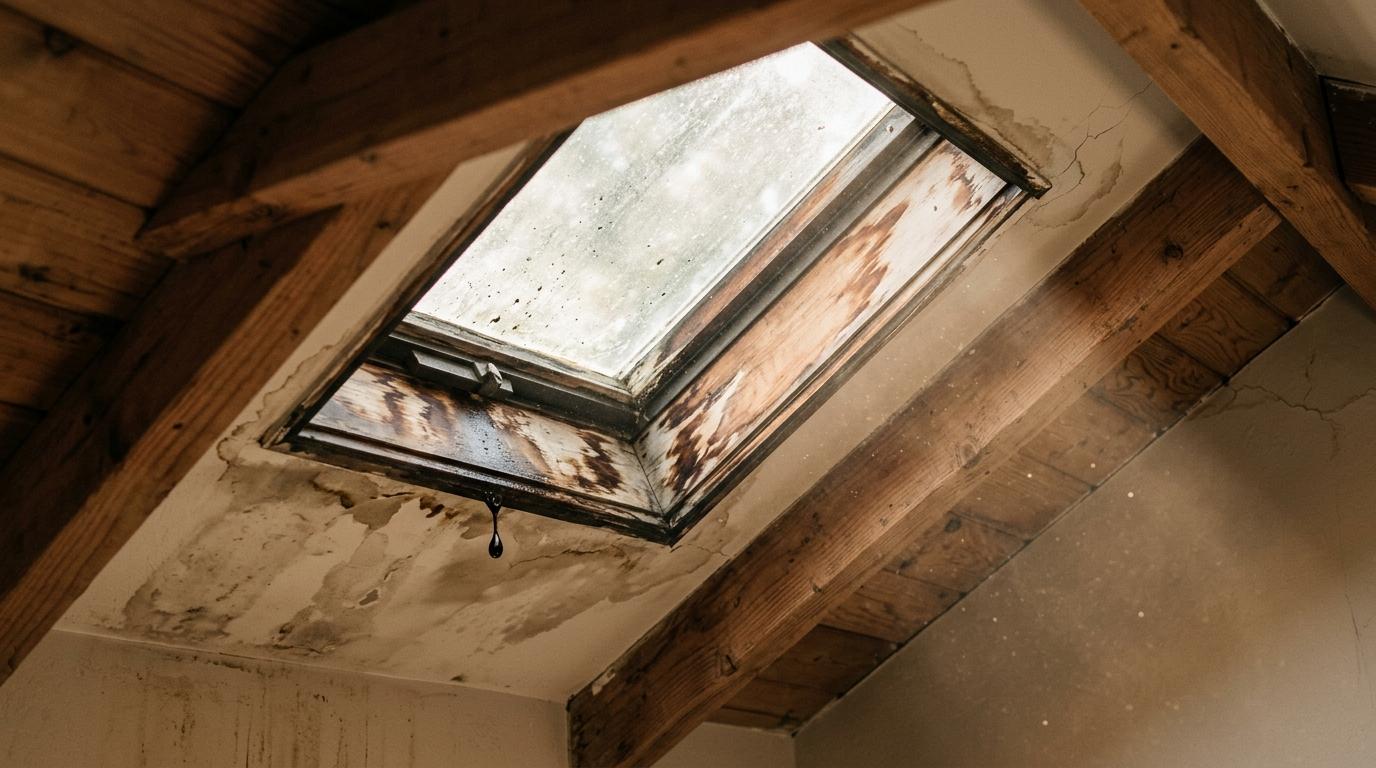
Skylight leak repair in the Sierra Foothills typically runs $200 to $1,400 depending on whether the source is flashing, a failed insulated glass seal, cracked sealant, or condensation that only looks like a leak. The first step is figuring out which of those four it actually is, because the fix and the price tag are very different. A botched diagnosis is how a $250 flashing touch-up turns into a $3,500 replacement six months later when water finally finds its way into the drywall.
I'm John, owner of Colfax Glass at 226 N Auburn St in Colfax. Our crew has been diagnosing and repairing leaking skylights across Placer and Nevada County for over 25 years, and we're an authorized VELUX dealer. Most of the leak calls we get from Colfax, Auburn, Grass Valley, Foresthill, and Nevada City fall into one of a handful of common patterns once you know where to look. This guide walks through how we diagnose a leak in the field, what each repair costs in 2026, and when a Sierra Foothills homeowner is better off replacing the unit than chasing the same leak twice.
TL;DR: A real skylight leak shows up around the frame edges, on rainy days, and stains drywall in a tear-shaped pattern. Condensation pools at the bottom track and clears once the room warms up. Flashing repairs run $200-$600, sealant resealing $150-$400, IGU seal replacement $400-$900, and full skylight replacement $1,200-$3,500. If your skylight is over 15 years old or a repair quote exceeds half the replacement cost, replace it.
Is It Actually a Leak? Condensation vs. Active Water Intrusion
Half the "leak" calls I take in October and November in the foothills turn out to be condensation, not roof leaks. The two look almost identical from a homeowner's chair on the couch, so it's worth knowing how to tell them apart before you call anyone or punch a hole in your ceiling looking for the source.
Condensation forms when warm, humid indoor air hits the cold inner surface of the skylight glass. It's worst on cold mornings, especially in kitchens, bathrooms, and laundry rooms. Water beads up on the glass, runs down the inner pane, and pools in the bottom track of the frame. From below, it can drip onto the floor exactly the way a roof leak would. The giveaway: condensation almost always shows up in cold weather, gets worse when the indoor humidity is high, and disappears once the room warms up and the indoor and outdoor temperatures equalize. We covered the underlying physics in detail in our window condensation causes and fixes guide, and skylights behave the same way — just at a steeper angle.
A real leak does the opposite. It correlates with rain or snow melt, not with indoor humidity. It often shows up on the drywall around the skylight shaft rather than on the glass itself, and the staining radiates outward in a tear-drop pattern as the water tracks along the framing before finding a low point. Real leaks also persist or worsen when the rain stops because trapped water in the assembly continues to drain for hours.
Pro tip: Before any contractor cuts into your ceiling, do the hose test. Spray water in 5-minute zones — first below the skylight on the down-roof side, then each side, then above. The leak almost always shows up within 10 minutes of hitting the right zone, which tells the installer exactly where to focus.
- Condensation pattern: water on glass, worse on cold mornings, clears with warm sunny weather, often seasonal
- Leak pattern: water on drywall around shaft, correlates with rain or snowmelt, leaves brown or yellow tear-shaped stains
- Both at once: a failed IGU seal can show condensation between the panes plus moisture intrusion — that's a replacement situation, not a fix
- Quick test: dry the area completely, run a hose on the roof for 20 minutes, watch for water — no water means condensation, water means a real leak
What Causes Skylight Leaks in the Sierra Foothills?
Most skylight leaks come from one of four failure points, and the foothill climate accelerates a couple of them faster than the California coast or Central Valley. Knowing which is which saves you from paying for the wrong fix.
Flashing failure is the number one cause. Flashing is the metal and membrane system that seals the gap between the skylight curb and the surrounding roofing material. Foothill homes get hammered by a freeze-thaw cycle that flat valley homes don't see — water gets behind a flashing edge, freezes overnight, expands, and pries the seam open just a little more each cycle. Over a few winters in Colfax or Foresthill, that's how a 15-year-old flashing job that worked perfectly through the first decade starts seeping. Pine needle and oak leaf debris on shingle roofs makes it worse by holding moisture against the flashing edges for days after a storm.
Sealant cracking is the second cause. The factory bead of butyl or silicone around the glass-to-frame joint dries out and shrinks under UV exposure. Sierra Foothills sun is brutal at elevation — the same UV that kills patio furniture in three summers eats sealant in five to eight years. Once the sealant cracks, capillary action pulls water in along the joint.
IGU (insulated glass unit) seal failure shows up as fog or moisture between the two panes. The argon gas leaks out, atmospheric moisture leaks in, and you get a permanent haze that no Windex will touch. Foothill elevation actually accelerates this — we covered the physics in our double-pane seal failure at elevation guide, and the same pressure differential works on skylight glass. Once the IGU fails, the only fix is replacing the glass.
Finally, structural movement and roof settlement open up gaps that the original installation handled fine. Older homes with redwood or doug fir framing in Grass Valley and Nevada City have settled and shifted enough that a 30-year-old skylight curb may no longer sit square. Add a couple of seasons of roof load from snow or wet leaves, and you can get a hairline gap at one corner that channels water inside.
| Leak Source | How It Looks | Repair Cost | Lifespan After Fix |
|---|---|---|---|
| Flashing failure | Stains on drywall around shaft, water during rain only | $200-$600 | 8-12 years |
| Cracked sealant | Drips along glass-to-frame joint, worse in heavy rain | $150-$400 | 5-8 years |
| IGU seal failure | Fog or haze between glass panes, won't wipe off | $400-$900 (glass only) | 15-20 years |
| Roof settlement / curb gap | One corner stains, often gradually worsening | $500-$1,400 | 10-15 years |
| Condensation (not a leak) | Water on glass, clears with warm weather | $0-$150 (humidity control) | Ongoing management |
How Much Does Skylight Leak Repair Cost in 2026?
Repair pricing in the Sierra Foothills runs noticeably below Sacramento metro and Bay Area rates because we're not commuting an hour each way and we don't carry the overhead of a metro shop. The chart below shows what Colfax Glass actually charges for the most common skylight leak repairs in 2026, alongside the typical metro range homeowners get quoted for the same scope.
Flashing repair is the most common job we run. If the existing flashing has only failed at one seam — usually the up-roof side where water sheets down — we can pull the flashing in that area, replace the membrane underlayment, and re-seat new step flashing under the next course of shingles. That's a 2 to 4 hour job for a two-person crew and runs $200 to $600. If the entire flashing kit needs replacement, we're looking at $500 to $900 because we have to pull shingles on all four sides.
Resealing the glass-to-frame joint is the cheapest legitimate repair. We strip out the cracked sealant, clean the joint to bare aluminum, and apply fresh marine-grade silicone or VELUX-spec butyl. Two-hour job, $150 to $400 depending on access and whether scaffolding is needed for steep roofs.
Glass-only IGU replacement on a VELUX skylight runs $400 to $900 if the frame is in good shape and the manufacturer still makes the glass cassette for that model. On older off-brand skylights, glass-only replacement is often impossible because the unit was never designed to be serviced — the whole skylight has to come out. We walked through the same decision tree for windows in our glass-only vs. full window replacement guide, and skylights follow the same logic.
The cost gap between repair and replacement narrows fast on older units. A $700 flashing repair on a 17-year-old skylight that's already showing seal fog is throwing money at a problem that's coming back. We'll tell you that to your face — we'd rather lose the repair sale and earn the replacement five years from now than do the repair twice.
Cost Comparison: Sierra Foothills vs. Sacramento Metro
The chart below shows the typical 2026 quote range for the four most common skylight leak repairs across the foothills versus the Sacramento metro market. The gap reflects labor rates, overhead, and travel time — not quality of work.
A Foresthill homeowner called us last fall after getting a $1,650 quote from a Roseville roofer for a flashing repair on a 12-year-old VELUX. We came up the next week, found that only the up-roof seam had failed, did the targeted repair for $385, and the skylight has been dry through this winter's storms. Not every job is going to be that lopsided, but the metro markup on small-scope repairs is real and worth getting a second quote for.
How to Diagnose a Leaking Skylight Step by Step
Before any repair, the source of the leak has to be confirmed. Here's the diagnostic walkthrough we use on every leak call. You can run the first three steps yourself before deciding whether to bring in a professional.
Start inside on a dry day. Look at where the staining or drip is appearing. Water on the glass itself usually means condensation or seal failure. Water on the drywall around the shaft means flashing or curb failure. Stains that radiate from one corner specifically point to localized flashing failure or roof settlement at that corner.
Next, check the attic if you have access. Look at the underside of the roof deck around the skylight curb. Dark staining on the wood, water marks running down the framing, or any rusted nail heads tell you water has been getting past the flashing for a while. Mold growth means the moisture has been ongoing — that's a sign you're past the early-warning stage.
Then do the hose test. On a dry day, dry the interior around the skylight completely, then have someone spray the roof in 5-minute zones starting low and working up. Below first, then each side, then above. The leak shows up within 10 minutes of hitting the right zone roughly 90 percent of the time. The down-roof side hardly ever leaks because gravity carries water away from that seam — it's almost always the up-roof side or one of the two side flashings.
Finally, check the age and brand. VELUX skylights have a serial number and date code stamped on the frame, usually visible from inside. Other brands often have a sticker on the curb that's still legible. If the unit is over 15 years old and you've already had one repair, you're at the point where the next leak is the third strike — replacement is the better long-term call.
- Step 1: Identify whether water is on the glass (likely condensation) or on the drywall around the shaft (likely a real leak)
- Step 2: Inspect the attic from below for staining, mold, or rusted fasteners around the skylight curb
- Step 3: Run the hose test on a dry day — 5-minute zones, low to high, watch for the source
- Step 4: Check the manufacturer date code and warranty status — VELUX No Leak units have a 10-year installation warranty
- Step 5: If repair history exists or the unit is over 15 years old, get a replacement quote alongside the repair quote
What's the Foothill-Specific Failure Pattern?
Sierra Foothills homes see a particular leak pattern that flat valley installs don't. The combination of elevation, pine and oak debris, and a freeze-thaw cycle that hits 30 to 60 nights a year creates a stress profile that flashing and sealants weren't necessarily engineered for in the 1990s and early 2000s. We installed plenty of skylights in Auburn, Colfax, and Grass Valley back when the spec was "good enough for Sacramento" — and we've replaced a lot of them since.
The failure pattern looks like this. Year one through eight, everything works fine. Year nine through twelve, the up-roof flashing starts showing minor staining on the attic side that the homeowner can't see. Year thirteen through fifteen, a heavier-than-normal storm year (we had two of those between 2023 and 2025) drives water past the weakened flashing and into the drywall. By the time the homeowner sees the stain inside, the underlayment and sometimes the framing have been wet for a season or more.
Elevation also affects the IGU seal differently than at sea level. We get into this in our winter window preparation guide for the Sierra Foothills and the double-pane seal failure at elevation guide, but the short version: the pressure differential between the sealed argon fill and the outside atmosphere flexes the seal more aggressively at 2,500 feet elevation than at 100 feet. Skylight IGUs at higher elevations in Foresthill or Nevada City fog up two to three years earlier than the same unit at Roseville elevation.
A second pattern we see often: clogged drainage channels. VELUX skylights have engineered drainage channels in the frame that carry condensation and minor weather penetration out to the roof surface. Pine needles, oak debris, and even seed pods from foothill ornamental trees clog those channels. Once the drainage is blocked, what should be a self-managing micro-leak becomes a backup that finds the next path of least resistance — usually the interior. A $0 fix that I tell every customer about: pull the screen off venting models once a year and clear the drainage holes with a toothpick.
Foothill heuristic: if your skylight is the original install from when the home was built and the home is over 18 years old, plan for replacement before the next major storm season rather than chasing repairs through one. The math works out roughly the same and the second visit is on your schedule, not the storm's.
Repair vs. Replace: How to Decide
The decision between repair and replacement comes down to four variables: age, repair history, repair scope relative to replacement cost, and the broader condition of the unit (especially the IGU). Here's the framework we use when quoting jobs.
If the unit is under 10 years old and this is the first repair, repair makes sense. Modern VELUX No Leak skylights are built for 25-plus years of service, so a single mid-life flashing repair is normal maintenance and gets you back to like-new. If the IGU is also clear and the frame is in good shape, you're nowhere near replacement territory.
If the unit is 10 to 15 years old with no prior repair history, repair still makes sense — but get a replacement quote alongside the repair quote so you know the gap. If the repair is under 25 percent of replacement cost, fix it. If it's over 50 percent, replace.
If the unit is over 15 years old or this is the second repair, replacement is almost always the better economic call. The next failure point is already in motion somewhere on the unit, and you're paying twice for repairs that aren't going to extend the total lifespan past the next replacement decision anyway. A foothill home should plan on roughly 20 to 25 years between skylight replacements with proper maintenance.
And if the IGU is fogged or hazed, the unit needs glass replacement at a minimum regardless of any other failure. On VELUX, glass-only replacement is feasible on most models and runs $400 to $900. On older off-brand skylights, the whole unit has to come out. The full cost picture for replacement is in our skylight replacement cost guide for California.
| Age of Skylight | Repair History | Best Decision |
|---|---|---|
| Under 10 years | No prior repairs | Repair the failure point |
| 10-15 years | First repair | Repair if cost is under 25% of replacement |
| 10-15 years | Second repair | Replace |
| 15-20 years | Any history | Replace, especially if IGU is fogged |
| Over 20 years | Any history | Replace — almost always the better long-term call |
When Should You Call a Professional vs. DIY?
Some skylight leak fixes are reasonably DIY-friendly if you're comfortable on a roof and have basic tools. Others should never be attempted by a homeowner. The dividing line is usually access, height, and whether the work involves opening up the flashing or roofing material.
DIY-reasonable fixes include: clearing drainage channels on a venting unit (toothpick and a vacuum, 10 minutes), reapplying surface caulk on a hairline interior crack (caulk gun and a putty knife, 30 minutes), and replacing the rubber gasket on a venting model that's compressed and no longer sealing. None of these involve cutting roofing material or working under shingles.
Not DIY: any repair that requires lifting flashing, pulling shingles, or replacing the IGU glass. The flashing system has a specific layering sequence — counter-flashing over step flashing over underlayment over deck — and getting the sequence wrong creates a hidden leak path that won't show up until the next storm. The IGU is heavy, fragile, and has to be set in a precise sealant bed without contaminating the sealing surface. We've replaced both glass and full units after well-intentioned DIY repairs that introduced bigger problems than the original leak.
The other factor is roof pitch and height. A single-story foothill home with a 4:12 pitch is one risk profile. A two-story Grass Valley home with a 9:12 pitch and a long fall to a hillside is a fundamentally different risk profile. The ER bills from a foothill roof fall start at five figures, and most homeowners don't have the right harness gear or anchor points. We carry the gear and the workers' comp, and our crew is on roofs four days a week — that experience matters more than tool selection.
When you do call a professional, ask three questions before signing anything: are you using VELUX engineered flashing or site-built (the right answer is engineered); will you guarantee the repair against leaks for at least one year (the right answer is yes); and have you replaced any roofing material that's reaching end of life under the existing flashing (often overlooked but critical). If the answers are vague, get another quote.
Free in-home leak assessments are part of how we do business. Whether the right answer ends up being a $200 sealant repair or a $3,500 replacement, we'd rather give you the right diagnosis than a fast one. Call (530) 346-6300 or request a quote on our site.
Repair Cost Distribution Across Sierra Foothills Calls
The chart below shows the rough breakdown of skylight leak calls we ran across Placer and Nevada County in 2024-2025. Flashing repairs dominate, IGU and condensation calls together make up another third, and full replacements account for the remainder.
A few takeaways. One in five calls turns out to be condensation, not a leak — that's a $0 fix once the homeowner adjusts indoor humidity, runs the bath fan longer, or installs a small dehumidifier. Flashing failures are dominant because the foothill freeze-thaw and debris environment grinds away at flashing faster than spec assumes. Full replacements stay in single digits because most failures can be addressed at the component level if caught early enough. The lesson: catch problems early, do the right diagnosis, and a lot of these stay in the $200-$600 range instead of escalating.
How to Prevent the Next Leak
Once a skylight is repaired, there's a maintenance routine that significantly extends the time before the next failure. None of this is exotic — it's the same routine I do on my own home in Colfax — and it adds maybe an hour a year to your home maintenance schedule.
Clear roof debris twice a year, in late fall after the leaves drop and again in spring after the last storms. Pine needles, oak leaves, and acorn caps trap moisture against flashing edges and accelerate every failure mode we've covered. Even a leaf blower from the ground (with a long-reach attachment) is better than nothing. We covered the broader winter prep playbook in our winter window preparation guide for Sierra Foothills homes.
Clear the venting unit drainage channels once a year. Pop the screen, check the small drain holes at the base of the frame, and clear any debris with a toothpick. This 10-minute job prevents one of the most common slow-leak patterns we see.
Inspect the visible flashing edges from the ground every spring. You're looking for lifted shingles, exposed nail heads, gaps where the flashing meets the curb, and any sealant that's cracked enough to be visible. If you can see daylight or a gap from the ground, water is getting in. Catching this in March and getting a $200 repair beats finding out in November when the first atmospheric river hits.
Keep an eye on the interior glass for any haze or fog between the panes. The first sign of IGU seal failure shows up as light condensation between the panes that clears later in the day. If you see it twice, plan for glass replacement within the next year — it gets worse, not better. The companion piece is our foggy double-pane window repair guide, and skylights track the same trajectory.
Finally, get the unit professionally inspected at year 10 and again at year 15 of its service life. A $150 inspection that catches a flashing failure before it gets into the drywall saves you the $500 to $1,500 cost of repairing the framing and ceiling damage that would have followed. The math is straightforward.
- Clear roof debris twice a year (late fall and early spring)
- Clear drainage channels on venting units once a year
- Visual flashing inspection from the ground every spring
- Watch for inter-pane haze or fog as an early IGU failure signal
- Schedule professional inspections at year 10 and year 15 of service life
Working With a Local Glass and Skylight Specialist
A roofing contractor and a glass specialist look at a leaking skylight differently. Roofers focus on the roofing material around the unit. Glass specialists focus on the unit itself, the IGU, the sealants, and the manufacturer-spec flashing system. For a leak that's clearly a roofing-side failure (the shingles around the curb are obviously toast), a roofer is the right call. For everything else, a glass specialist usually delivers a better diagnosis and a longer-lasting repair.
Colfax Glass has been the local skylight specialist for the Sierra Foothills for over 25 years. We're a VELUX authorized dealer, which means we have direct access to manufacturer flashing kits, replacement glass, and warranty support that general contractors typically don't. We service Colfax, Auburn, Grass Valley, Nevada City, Foresthill, Loomis, Rocklin, Roseville, and the surrounding Placer and Nevada County foothills. If you've got a leak you're trying to diagnose or a repair quote you want a second opinion on, free in-home assessments are part of how we work — call (530) 346-6300 or request a quote and we'll get someone out within the week.
One last note. Whatever you decide — repair, replace, or just keep an eye on it — don't let an active leak sit through a storm season. Even a small leak compounds fast in foothill winters: wet insulation loses R-value, framing rots, and what was a $300 fix in October becomes a $4,000 ceiling repair in February. The cheapest skylight leak is the one you address before it gets into the drywall.